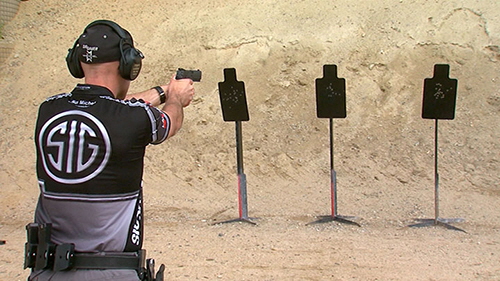
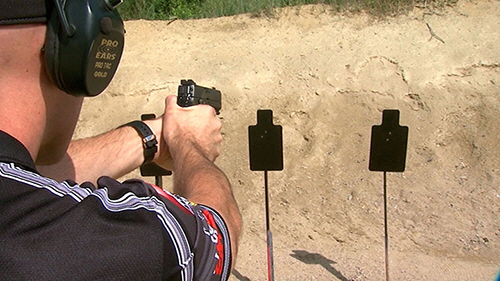
Transitions, one of the typical time savers in any course of fire when shooting, and that’s what we are going to be covering: how to effectively transition the pistol from one target to the next with a couple of key aspects. What I am seeing visually, as well as what I am doing physically.
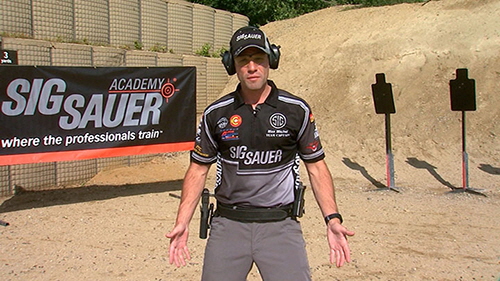
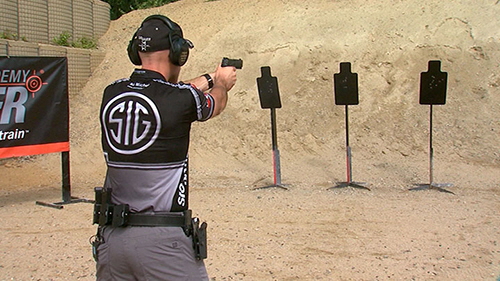
Let's start with the physical part. Now my stance is wider than shoulder width apart for stability.
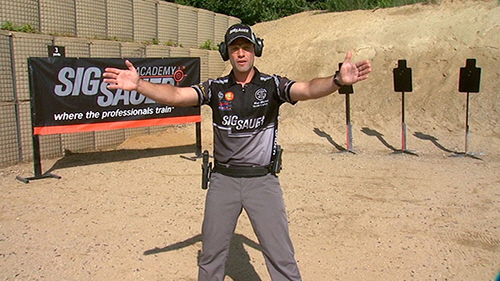
As I drive the handgun from one target to the next I can maintain my balance as well as get the sights stabilized on the next target sooner. Also, if I draw an imaginary line from my feet straight down range, this is what I call my sector of fire.
Everything within my sector of fire, I can now get to consistently, but more importantly, keeping my natural point of aim behind each shot. I am primarily utilizing my lower body to drive from target to target; however, my upper body is assisting and pulling into that next direction. I am not going to lock out my knees and utilize my upper body as a tank turret because it is slow and ineffective and difficult to land in a specific spot at a high rate of speed.
So by bending my knees I can utilize my lower body to drive me there quickly and my upper body to pull and assist.
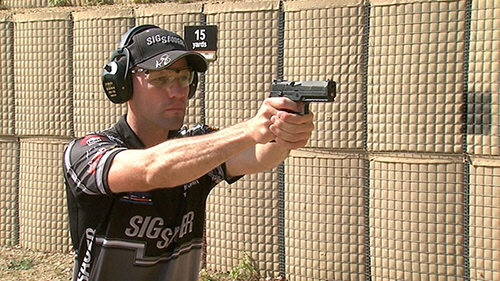
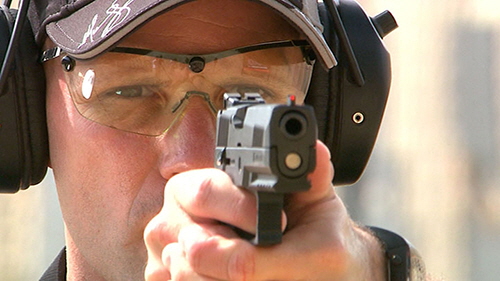
Let's talk about what we are going to see visually now. With a safe and clear firearm, allow me to demonstrate what I see visually. Once the sight lifts off the particular target that I am engaging, the first thing that I am going to do is my eyes are going to rotate in their sockets and locate a specific spot on the next target that I want to engage.
At that moment all being driven my lower body, my shoulders will follow, my arms will follow, my hands will follow and then of course the gun will come back into my peripheral vision.
Once the gun comes into my peripheral vision, my focus will then shift from the specific spot on the target I want to engage to that front sight, and once the sights are acceptable, depending on the distance and the difficulty of that shot, it's now time to activate the trigger.
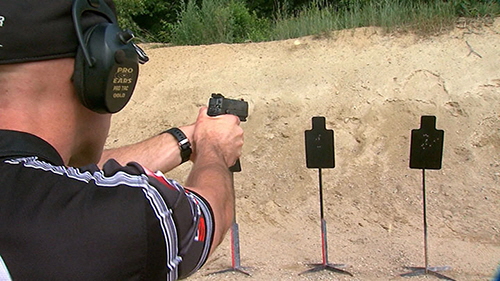
Now, let's put all of that together in live fire and see what it looks like. During my live fire portion I ran it left to right as well as right to left. Regardless of whatever your preference is, as far as which direction you want to shoot, it's important to be able to do both and here’s a great tip o be able to work on that.
In this drill you want to eliminate target two, which is essentially going to give you target one and target three at about two to three yards apart.
Now what I am going to do is work myself right to left as well as left to right. I will start on target three go to target one, back to target three, and finally finishing on target one once again, all while keeping my legs driving to that next target, and keeping my eyes moving to the specific next spot.
The transition is not just a skill needed for competitive shooters. It’s critical for law enforcement, military, and anyone out there protecting their families, to be able to do at a high rate of speed.
A couple of key things to remember is that wide aggressive platform, that’s going to allow you to drive the gun quickly from one target to the next while maintaining your balance and your stability on that next target. Visually be sure to get your eyes moving ahead of the gun so you can locate a specific spot on that target you want to engage. So, now it’s up to you to get to the range and maximize your potential.