|
 Shooting USA - The Guns of the USPSA Shooting USA - The Guns of the USPSA
This time we are Sighting In on the guns of the USPSA limited and production super-squads. It’s a look at the handguns in use by the best practical shooters in the nation.
John Scoutten has the report on the top shooters hardware from this year’s nationals.
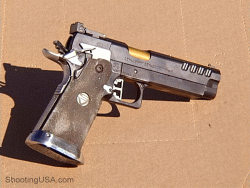 Limited Division Guns Limited Division Guns
EAA Witness
SV Infinity Millennium
USSA Custom
STI 2011 five inch
Caspian Hi-cap (Frame Only)
Springfield Armory High Capacity (Not for Sale)
Para High Capacity
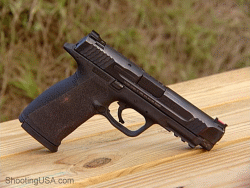 Production Guns Production Guns
Smith & Wesson M&P 9mm
S&W M&P 45ACP
CZ-75 SP-01
Glock model 35 - 40 S&W
Glock model 34 - 9mm
Sighting In on Camouflage
 Have you ever been sitting in a duck blind, looking at perfectly printed leaves and bark on your shotgun, and wondered, “How do they do that?” We’re the guys who make it our job to find the answers, so now you’re going to know how from a tour of the Stoeger Factory. Have you ever been sitting in a duck blind, looking at perfectly printed leaves and bark on your shotgun, and wondered, “How do they do that?” We’re the guys who make it our job to find the answers, so now you’re going to know how from a tour of the Stoeger Factory.
The process begins with surface preparation. For the plastic parts of what will be a shotgun, that means time in the vibrator to be sure the primer coat will get a permanent bond.
The next step is two coats of primer with a paint that is formulated to bond permanently to the gun parts and also provide a bonding surface for the inks of the camo pattern. The camo is printed on a thin transparent sheet, known as the carrier. The technician floats the pattern and the carrier on a tank of 100 degree water. It takes one minute for the water soluble carrier to dissolve, leaving just the inks floating on the surface.
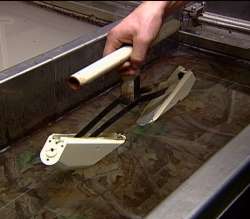 The inks are solvent based and only become soft and sticky when the technician sprays solvent on the surface. He has about 30 seconds for the application, which is done by easing the parts down through the film of ink as the water pressure in the tank forces the pattern onto every exposed surface of the part. The inks are solvent based and only become soft and sticky when the technician sprays solvent on the surface. He has about 30 seconds for the application, which is done by easing the parts down through the film of ink as the water pressure in the tank forces the pattern onto every exposed surface of the part.
Next is a rinse in the wash cabinet to remove any traces of the plastic carrier sheet that may have stuck to the inks and the part. Then is hand touch-up using the same inks and a fine brush for any areas of the part that may need a stroke of color to be perfect. And, finally, a coat of polyurethane to protect the finish.
Related Link: Stoeger Shotguns
Sighting In on Ignition Systems
 We’re tracing the developments, from Flint and Steel, to Firing Pin, Primer and Cartridge. We’re tracing the developments, from Flint and Steel, to Firing Pin, Primer and Cartridge.
It has been more than 400 hundred years since the Pilgrims landed at Plymouth Rock in Massachusetts, with the guns they would use to hunt and to secure their new settlement. Those guns were hand built flintlocks, touched off by a spark of flint on steel. In the centuries since, firearms technology has advanced dramatically, driven by the need to defend the nation, with advancements coming most often during times of war.
 With the help of our friends from the NMLRA and the N-SSA, we’re taking you back to the challenge of developing ignition systems that would lead to the firearms of today. With the help of our friends from the NMLRA and the N-SSA, we’re taking you back to the challenge of developing ignition systems that would lead to the firearms of today.
Related Links:
The National Muzzle Loading Rifle Association
The North-South Skirmish Association
Thompson Center Triumph Muzzle Loader

50 Caliber $450 in Black $499 Camo
Thompson Center Link (caution: sound on home page)
Reloading Tips from Allan Jernigan –

Allan explains the RCBS X-die that will save you time.
X-Die
Pro Tips –
|